Hydroponic barley fodder · seed to feed in seven days
Fresh fodder, winter and summer.
Grown indoors on trays, barley grain becomes fresh green fodder in seven days, whatever the weather outside. Our system is still a prototype, but we’re already taking preorders.
- Water vs. pasture, typical
- −90%
- Seed to feed
- 7 days
- Days a year it can grow
- 365
- Pesticides
- 0
The company
We saw the climate changing faster than farming. So we got to work.
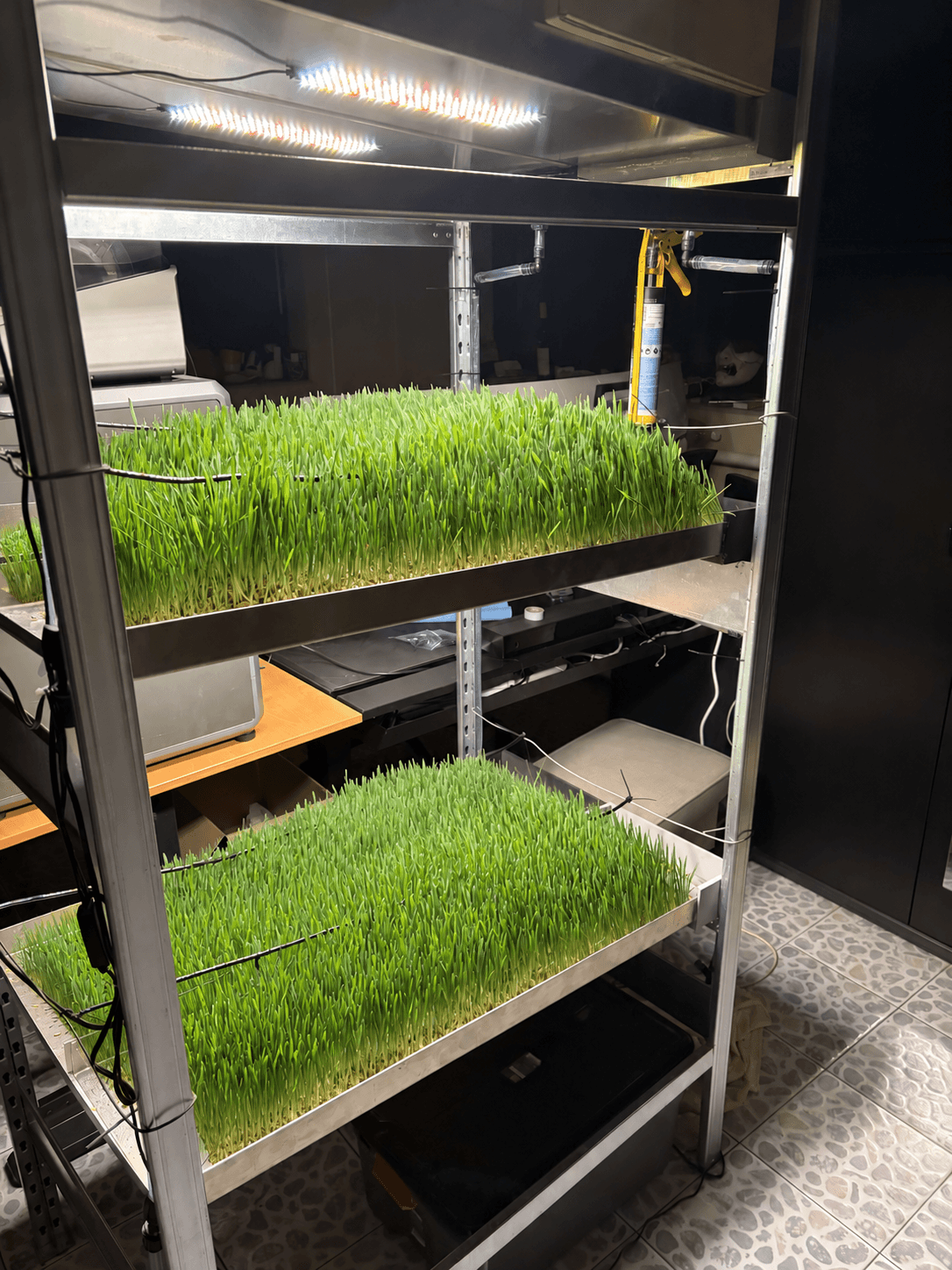
We’re not farmers. We’re software developers who love being outdoors, and we kept seeing the same pattern: longer droughts, erratic seasons, and feed prices spiking every time the weather broke. Feed is the oldest input in farming, and a changing climate is making it the least predictable one. We thought a controlled, measured indoor system could help with that.
We started building one. Our prototype turns barley grain into fresh green fodder in seven days. What the field leaves to weather and luck, timed watering and lighting handle here, and sensors keep track of temperature and humidity. It needs no soil and no pesticides, and per kilogram it uses about a tenth of the water of conventionally grown fodder. We’re using it to tune the growing cycle and measure yields before we build a system big enough to feed a whole herd.
- Founded
- 2026
- Background
- Software development
- Stage
- Prototype, taking preorders
- Based in
- Budapest
The process · one growing cycle
Watch a tray grow.
Day 1
Soak & seed
Barley grain is soaked for twelve hours, then spread a finger deep across food-grade trays. There’s no soil: the grain itself holds everything the sprout needs.
Moisture 45% · 21 °C · light off
Day 2–3
Germination
In the dark of the climate room the grain wakes. White root hairs reach down and knit the loose seed into a single living mat.
Moisture 60% · 21 °C · light off
Day 4–5
First green
Shoots break upward and meet the grow lights. Chlorophyll switches on, and the tray turns from pale gold to green in a single day.
Moisture 68% · 21 °C · light on
Day 6
Canopy
The blades close ranks into a dense sward. Enzymes, vitamins and digestible protein are climbing toward their peak.
Moisture 70% · 21 °C · light on
Day 7
Harvest
The mat of roots, remaining grain and 25 cm of green blade lifts out of the tray in one piece and is fed whole, roots and all.
Moisture 72% · 21 °C · light on
Why fodder
What a controlled seven days does for your herd.
Fresh green feed in any season
Sprouted barley typically has 14–16% crude protein in dry matter, a little more than the grain it grows from. It’s fed alongside hay as the fresh, green part of the ration.
A film of water instead of a field
The trays recirculate a thin film of water, so a kilogram of fodder takes a fraction of what pasture or irrigated hay needs.
Drought, frost and heatwave-proof
Indoors, the season doesn’t matter. Barley grows the same way in January as in July, whatever the forecast says.
Nothing on it but water and light
A sealed, controlled room needs no herbicides or sprays. What comes off the tray is grain, root and green blade, and nothing else.
A supplement next to hay
Research on cattle, sheep and goats suggests feeding it at roughly 10–30% of the ration’s dry matter, alongside hay or other roughage. It doesn’t replace roughage.
Roots, seed and blade, fed fresh
The whole mat is cut up and fed fresh, roots and all. Kept clean and free of mould, it’s usually eaten readily, so hygiene matters most when growing it.
Preorders
We’re taking preorders now. Tell us what your herd needs, and we’ll agree the details with you.
Working together
Three ways to get started.
We’re at the prototype stage, so we agree everything individually with each farm.
Preorder fodder
Tell us how much fodder you’d need and how often. We record your preorder and get in touch once we’re able to supply it.
- Quantities sized to your herd
- Timing and price agreed in advance
- We tell you as soon as we can supply
Questions about fodder
Not sure whether sprouted fodder suits your animals? Ask us. We’ll share what the prototype has taught us and point you to the published research.
- What we’ve measured so far
- Published feeding trials
- Straight answers, including when we don’t know yet
Larger quantities
Feed stores, cooperatives and larger farms are welcome to get in touch. We’ll tell you honestly what we can supply, and from when, as the system grows.
- Volumes discussed individually
- Our scaling plans, shared openly
- One person to talk to
Build log
Three prototypes, one plan.
Every version taught us something the next one had to fix. These are our own photos, from the first shelf to the rack we’re testing now.
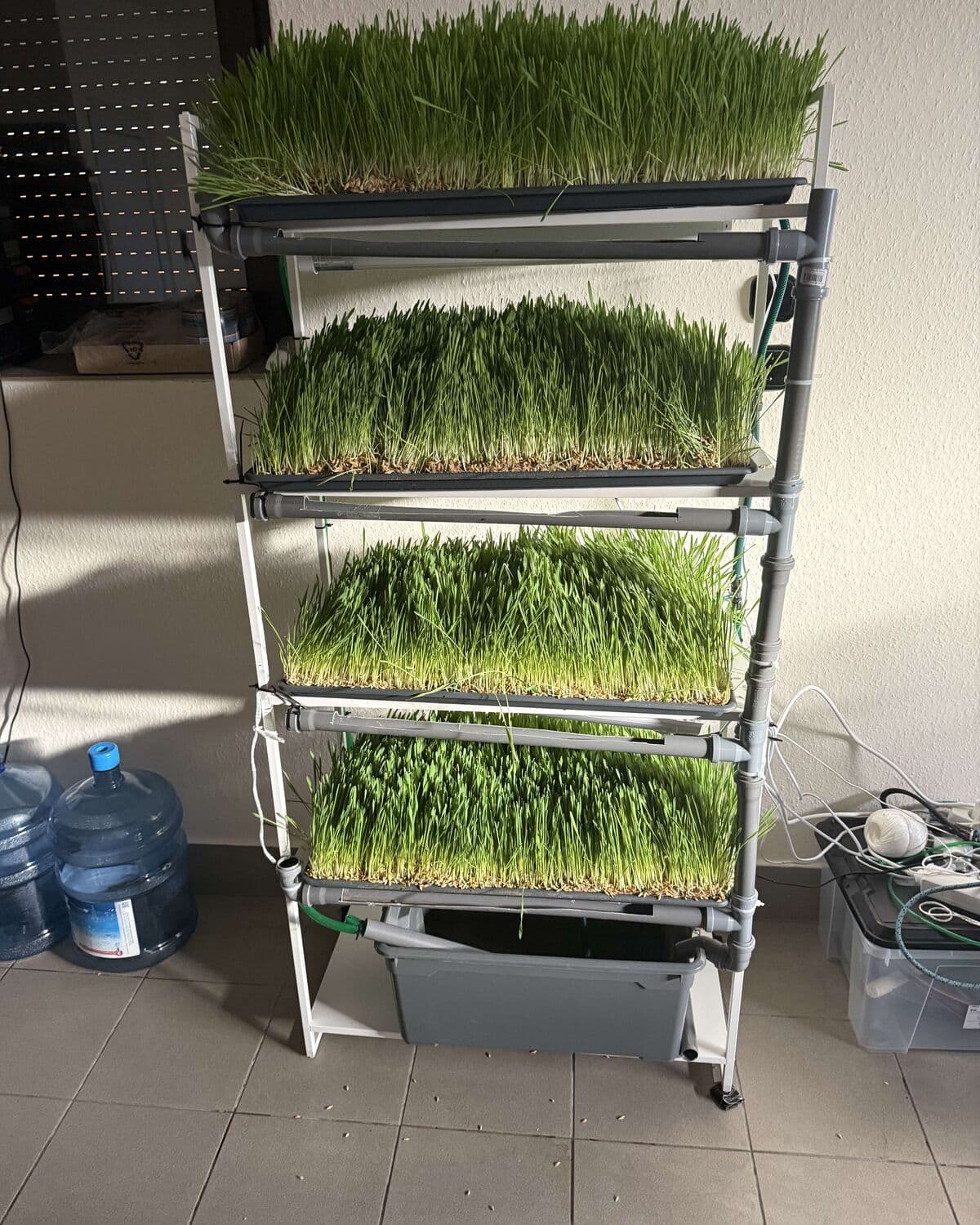
Prototype 01 · September 2025
The first shelf
A white shelving unit, four plastic trays, a tube light, and a tank at the bottom with a pump that keeps the water circulating. Simple, but it answered the first question: barley does grow into a dense green mat indoors.
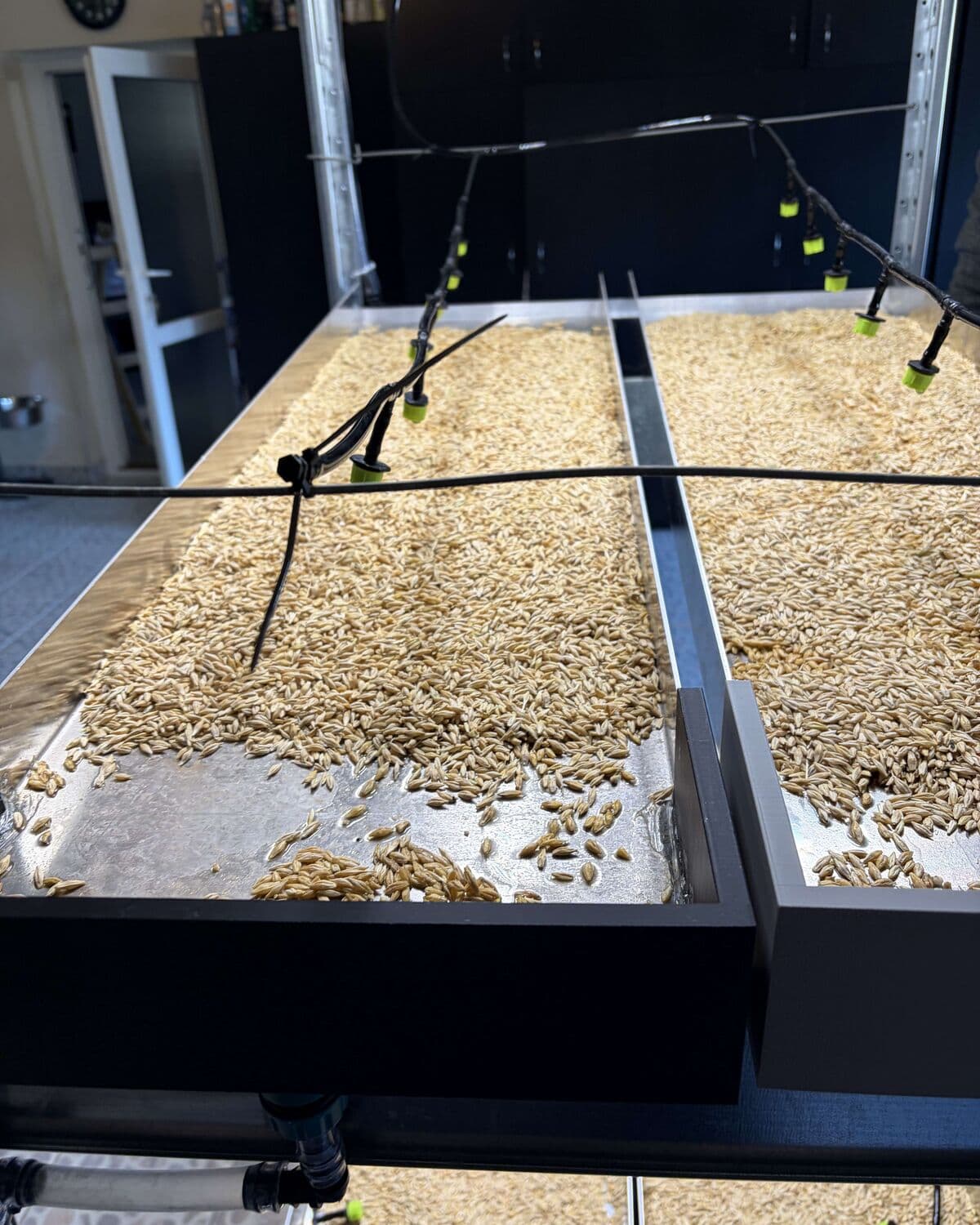
Prototype 02 · March 2026
Metal trays and drip lines
We moved to bigger metal trays on a galvanized rack. Drip emitters spread the water evenly over the grain, and LED grow lights replaced the tube light.
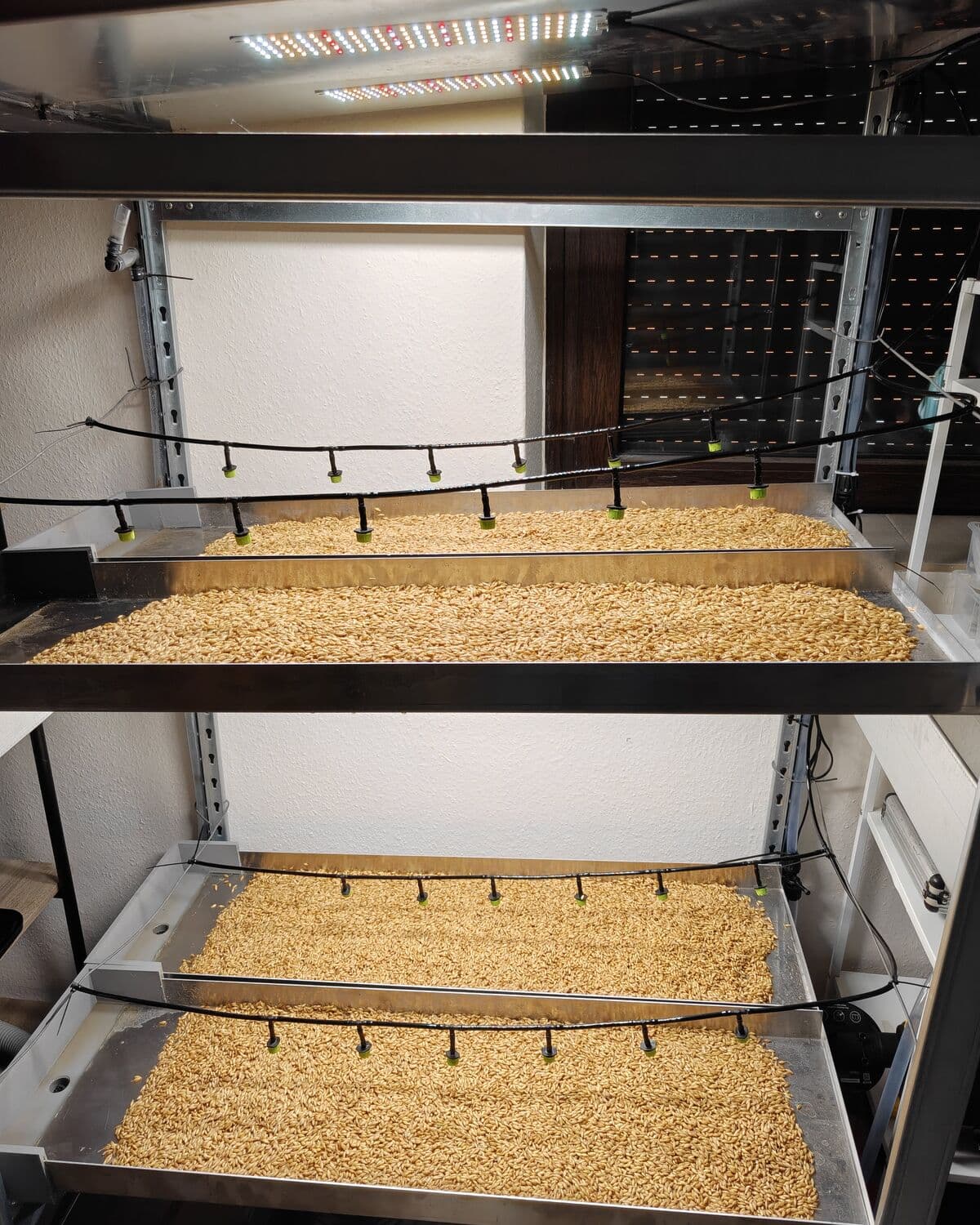
Prototype 03 · September 2026 · now
Our current prototype
Two rows of drip emitters over every tray. This is the rack we’re testing now: we use it to fine-tune the cycle and measure yields. It isn’t a production system yet.
 Visualization
Next step
The planned growing room
This is how we picture the next step: several racks of the same design in one room. The image is a visualization; the room hasn’t been built yet.
Founding farms
We’re new, so there are no testimonials here yet. We’d rather show you the trays.
Our prototype is running, and we’re looking for a handful of farms to take the next step with. Later, this page will hold their words instead of ours.
01 · Founding price
Farms that preorder now get a founding price, agreed with you in advance.
02 · A direct line
You talk to the people who built the system. What you tell us shapes how it runs.
03 · A say in the details
Delivery days, quantities and routes aren’t fixed yet. The first farms help us decide how it all works.
FAQ
What to know about sprouted fodder.
Short, straight answers. The figures come from published research; the sources are listed below.
What is hydroponic barley fodder?
Barley grain sprouted in trays with water and light, without soil. In about 6–8 days it grows into a 20–30 cm mat of roots, remaining seed and green shoots, which is fed fresh to livestock.
How much water does it use?
Published figures are about 1.5–2 litres of water per kilogram of fresh fodder, against roughly 73–160 litres per kilogram for barley, alfalfa or grass grown in a field. That doesn’t include the water used to grow the seed grain.
Can it replace hay?
No. It’s a supplement. Research on cattle, sheep and goats suggests feeding it at roughly 10–30% of the ration’s dry matter, alongside hay or other roughage. When much more was fed, animals ate less overall, and dairy cows gave less milk.
Which animals can eat it?
Mainly cattle, sheep, goats and horses, and in some systems rabbits and pigs. For horses the research is thin, and nutritionists advise feeding it alongside hay.
How nutritious is it?
Sprouted barley typically has 14–16% crude protein in dry matter (reported values range from about 10% to 22%), a little more than barley grain at about 12%. The fresh mat is roughly 85% water, so compare it with other feeds on a dry-matter basis.
Is it cheaper than grain or hay?
Not per kilogram of dry matter. Most published economic studies find that sprouted barley costs two to five times as much per kilogram of dry matter as the grain it grows from, because some dry matter is used up during sprouting, and labour and equipment add to the cost.
It can pay off where water, land or roughage is scarce or expensive, as in drought years. We’re measuring our own costs on the prototype and will share them.
Can I order now? When will you deliver?
You can place a preorder now through the contact form. Our system is still a prototype, so we can’t give a delivery date yet. We’ll contact every farm that preorders as soon as we can supply, and agree quantity, timing and price with each one.
How much does it cost?
We haven’t set a price yet. If you preorder now, you get a founding price, agreed with you in advance.
What are the risks?
Mould is the main one. Sprouting trays are warm and wet, and mouldy fodder can make animals ill. Clean trays, good ventilation and a controlled climate prevent it, which is why we grow in a closed, controlled environment.
Who is behind Green Fodder?
We’re software developers in Budapest who love being outdoors and wanted feed that doesn’t depend on the weather. The company behind Green Fodder is KápiFiveSome Kft. We started building prototypes in 2025 and have built three so far; they’re in the build log above.
Sources
- Bakshi, Wadhwa & Makkar (2017): Hydroponic fodder production, a critical assessment. FAO / Feedipedia
- Systematic review of hydroponic fodder in ruminant feeding. Animals 15(24), 3544 (2025)
- University of Vermont Extension (2016): Fodder systems fact sheet
- Sneath & McIntosh (2003): Review of hydroponic fodder production for beef cattle. Meat & Livestock Australia
- Fazaeli et al. (2011): sprouted barley in feedlot calf diets. J. Agric. Sci. Technol. 13(3)
Contact
Tell us about your herd.
Tell us how many animals you feed, where you are, and roughly how much fodder you’d need. We’ll record your preorder and get back to you to talk it through.
- greenfodder@kapi5.hu
- Based in
- Budapest
Our system is still a prototype, so we agree quantities, timing and price with each farm individually. If you’d rather talk on the phone, leave your number in the form and we’ll arrange a time.